
While blogs don't often have original reporting from professional journalists, they do collect information from many places to provide a new angle or contextual idea about a topic. Adam Gaffin (a professional journalist) has took this idea to heart by creating Universal Hub in 2005. Universal Hub, a play on the nickname "Hub of the Universe," collects alternative news about Boston and New England at large in one place.
Gaffin, who spoke to my class on Wednesday, say he started the project because he was tired of Boston mainstream media's lack of coverage on what he thought were interesting news stories. After a murder happened in his quiet town without any coverage from the Boston Globe, he decided he needed to create a sounding board to post this kind of pertinent news.
Universal Hub takes from hundreds of Boston bloggers and breaks down news by neighborhood or topic. Gaffin, who also edits a technology trade magazine, has a background with computer programming, so creating such a user-friendly blog was no problem for him. He encourages up-and-coming bloggers to target a niche and says advertisers will pay to reach that untapped audience. Though Universal Hub is only a sidejob for Gaffin, it's has come to play an important role in Boston journalism.
Showing posts with label Reinventing the News. Show all posts
Showing posts with label Reinventing the News. Show all posts
Thursday, December 4, 2008

Tuesday, December 2, 2008
Reinventing the News: Twitter
In our ADD generation, it seems that instantaneous blog posts aren't enough. Instead, posts need to be shorter, quicker and able to record play-by-play news. Enter Twitter, a social media network that limits people's entries to 140 characters and allows constant updating.
Readers of Twitter mainly follow people, with posts much like Facebook's status updates, rather than news organizations. I find in many ways Twitter serves to validate meaningless minutiae about poster's everyday life: sometimes funny, occasionally candid, but mostly trivial. However, more news outlets are jumping on the 2-year-old technology as a way to reach more people, though not all of them are understanding Twitter's strengths and weaknesses. The BBC, for example, uses Twitter only as a promotional tool for publicizing any new article on their site. At this moment, it's news people, not news organizations, using Twitter the best.
Two such individuals are Andy Carvin and Jim Long. Carvin utilizes Twitter's strength of a way to report on minute-by-minute developments by "tweeting" through tech news conferences and political campaign events. As a new media reporter for National Public Radio, Twitter is just one of the many ways Carvin is working with online tools to reinvent journalism. Long, a cameraman for NBC's Washington Bureau, chronicles the details of shooting interesting news stories for TV. His account of the challenges and interesting places he's in puts TV news packages in a totally different light. Both Carvin and Long come from non-print news outlets, and perhaps its the limit of word count that has lended itself so well to these reporters.
The online persona Max Gladwell is not a person at all but rather a collective of posters concentrating on social media and green living. But with Twitter not allowing much room for a personal voice in one's writing, the tweets read as if from one person. MG highlights news articles with a phrase and a link and lets the reader come to their own conclusion.
What I like about these sites is they interact with their followed Twitters and readers. They link to sites and point out information they find relevant and interesting, offering at times concise analysis if any at all. But while Twitter may be perfect for covering events, I don't think it offers any new technology that a simple blog couldn't do. It's the community around Twitter that makes the site so appealing.
Readers of Twitter mainly follow people, with posts much like Facebook's status updates, rather than news organizations. I find in many ways Twitter serves to validate meaningless minutiae about poster's everyday life: sometimes funny, occasionally candid, but mostly trivial. However, more news outlets are jumping on the 2-year-old technology as a way to reach more people, though not all of them are understanding Twitter's strengths and weaknesses. The BBC, for example, uses Twitter only as a promotional tool for publicizing any new article on their site. At this moment, it's news people, not news organizations, using Twitter the best.
Two such individuals are Andy Carvin and Jim Long. Carvin utilizes Twitter's strength of a way to report on minute-by-minute developments by "tweeting" through tech news conferences and political campaign events. As a new media reporter for National Public Radio, Twitter is just one of the many ways Carvin is working with online tools to reinvent journalism. Long, a cameraman for NBC's Washington Bureau, chronicles the details of shooting interesting news stories for TV. His account of the challenges and interesting places he's in puts TV news packages in a totally different light. Both Carvin and Long come from non-print news outlets, and perhaps its the limit of word count that has lended itself so well to these reporters.
The online persona Max Gladwell is not a person at all but rather a collective of posters concentrating on social media and green living. But with Twitter not allowing much room for a personal voice in one's writing, the tweets read as if from one person. MG highlights news articles with a phrase and a link and lets the reader come to their own conclusion.
What I like about these sites is they interact with their followed Twitters and readers. They link to sites and point out information they find relevant and interesting, offering at times concise analysis if any at all. But while Twitter may be perfect for covering events, I don't think it offers any new technology that a simple blog couldn't do. It's the community around Twitter that makes the site so appealing.
Monday, November 24, 2008
Reinventing the News: NewsTrust
 So much information is spread on the Internet as news, but how much of it is ethical reporting? That's where NewsTrust comes in, a site designed for professional journalists and news junkies to rate the quality of news stories.
NewsTrust is working with Northeastern University in rating Global Economy stories. Tonight I rated three economic stories, beginning with reports of British Prime Minister Gordon Brown's potentially unpopular stimulus plan to kick-start the country's economy. The unpopular part comes with new taxation. Next I took a look at China during the economic crisis with a report on housing projects funding and an opinion piece on China's attempts to build confidence through proposed major spending. Both pieces had a mixed tone, seemingly acknowledging China's potential but also fearing the county's success.
It's easy to point out the lack of context in many of these articles, but it's important to remember that many of these stories serve only to report on that moment's news, not an analysis of a whole issue. Context and sourcing were my major issues when rating articles, but it's always easier to rate something than to do it yourself.
NewsTrust is a great idea in that it highlights well-written and researched reports for the public from a variety of sources , but it lacks a major component of all successful online tools: numbers. Popularity is so crucial for influential websites, and NewsTrust has a very small community of dedicated readers and raters. Instead of attracting journalists already in-the-know, average readers need to trust NewsTrust as their go-to news source.
Wednesday, November 12, 2008
Reinventing the News: Caffeinated Campus Map
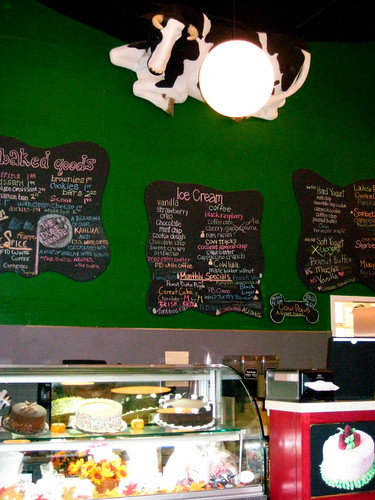 As part of our experimentation with GoogleMaps, my class has collaborated on an interactive presentation of all the coffee shops around campus. In contrast to the plenitude of liquor stores near my Mission Hill apartment, there's a sad lack of coffee shops. It may look bleak with only 7-11 and Dunkin' Donuts, but JP Licks provides a nice refuge for people who want to enjoy their cup of coffee instead of getting a quick and cheap caffeine fix before the morning commute.
JP Licks, named after the Jamaica Plain area of Boston, is known more for its ice cream than coffee, but the cafe has a wide range of Fair Trade Organic styles. $1.85 will get you a medium coffee, and the place has WiFi and enough room to comfortably sprawl out. The staff, while usually hanging out in the back, is very friendly, and there was a good mix of college students and young professionals enjoying a Tuesday afternoon with a book in hand or a computer in front of them. While JP Licks will never become a cafe destination, it's a good place to get away from your TV and get the needed caffeine to finish that last minute paper.
Monday, November 10, 2008
Reinventing the News: Maps
I'm not obsessed with celebrities the way some blog-readers are, but I definitely get the occasional kick from the oddities of a celebrity only discovered when their army of PR people aren't around. Enter GawkerStalker. When I lived in Manhattan, I would check the GawkerStalker map to see how interesting (or boring) celebrities found the neighborhoods I lived and worked.
The beauty of this map-based celebrity sighting system as opposed to new stories is that these Google Map presentations are non-linear. Like me checking GawkerStalker around my neighborhood, the reader can enter a map news presentation anywhere pertinent to them. GawkerStalker also adds another level of audience interaction: the sighting tips are submitted by local Manhattanites with their own analysis, usually interesting and slightly funny. These are updated daily. Of course, leave it to PR flacks to work Stalker for their own benefit: with the launch of her new show soon, many overtly nice sightings of Whitney Port starting pouring in to Stalker presumably from her PR hacks. Gawker did not post them.
The beauty of this map-based celebrity sighting system as opposed to new stories is that these Google Map presentations are non-linear. Like me checking GawkerStalker around my neighborhood, the reader can enter a map news presentation anywhere pertinent to them. GawkerStalker also adds another level of audience interaction: the sighting tips are submitted by local Manhattanites with their own analysis, usually interesting and slightly funny. These are updated daily. Of course, leave it to PR flacks to work Stalker for their own benefit: with the launch of her new show soon, many overtly nice sightings of Whitney Port starting pouring in to Stalker presumably from her PR hacks. Gawker did not post them.
Thursday, November 6, 2008
Reinventing the News: Spikey Em
Boston Globe reporter Emily Sweeney spoke to my journalism class this week about her work in online video and other mulitmedia projects. Sweeney graduated a decade ago from my university, and her return to my school really reinforced how much journalism has changed in the last ten years. A Globe reporter for the last seven years, she is also the New England President for the and Society for Professional Journalists.
In our financially troubled times, Sweeney has carved a niche for herself by being the Globe's video reporter. She started the first video blog for the newspaper in September 2006. Like Steve Garfield who previously spoke to my class, Sweeney's video skills are definitely rough. But online video for newspapers are a new field, and many older, established newspaper reporters, while excellent journalists, don't have the basic knowledge of computers young people have. Her early interest in technology has made her a go-to girl for Globe videos.
Many of Sweeney's videos are simply things she finds entertaining or interesting, very rarely hard news. Sweeney, who goes by the moniker Spikey Em due to her ultra-gelled hair, showed our class a few of her projects, including a video about Boston slang. While some of the vocabulary she features are universal (since when is "book it" only used in Boston), her video is an example of the World Wide Web's local appeal. Though this video has the potential to reach all corners of the globe, publications have had the most success by appealing to a local or niche market through the Internet.
Her videos have been a learning process for her too. In her video last year documenting the decline of Bingo's popularity in Boston, she narrated without any script. She has since learned that a script is necessary for any video work, no matter how comfortable you may think you are with the subject. For more tips of the trade, Sweeney has authored a How-to Multimedia guide for journalists that appeared in Editor & Publisher and Quill Magazine in 2006.
In our financially troubled times, Sweeney has carved a niche for herself by being the Globe's video reporter. She started the first video blog for the newspaper in September 2006. Like Steve Garfield who previously spoke to my class, Sweeney's video skills are definitely rough. But online video for newspapers are a new field, and many older, established newspaper reporters, while excellent journalists, don't have the basic knowledge of computers young people have. Her early interest in technology has made her a go-to girl for Globe videos.
Many of Sweeney's videos are simply things she finds entertaining or interesting, very rarely hard news. Sweeney, who goes by the moniker Spikey Em due to her ultra-gelled hair, showed our class a few of her projects, including a video about Boston slang. While some of the vocabulary she features are universal (since when is "book it" only used in Boston), her video is an example of the World Wide Web's local appeal. Though this video has the potential to reach all corners of the globe, publications have had the most success by appealing to a local or niche market through the Internet.
Her videos have been a learning process for her too. In her video last year documenting the decline of Bingo's popularity in Boston, she narrated without any script. She has since learned that a script is necessary for any video work, no matter how comfortable you may think you are with the subject. For more tips of the trade, Sweeney has authored a How-to Multimedia guide for journalists that appeared in Editor & Publisher and Quill Magazine in 2006.
Tuesday, October 28, 2008
Reinventing the News: Steve Garfield
Steve Garfield is the classic example of the 21st century journalist--or should I say 21st century blogger? As he told my class last week, he calls himself a videoblogger, but more so, he is a business model for any average journo with a camera and a computer. Due to his aptitude for utilizing the latest technology, Garfield has reported for RocketBoom and The UpTake as well as his own site, and in addition now teaches at Boston University.
Garfield's videos are not technically impressive. They are rough and sometimes unedited, almost always amateur looking. But what makes Garfield special is that every opportunity is a possible video reporting opportunity for him--whether it be catching a politician on the street with his cell phone or documenting his wife making an unremarkable comment while watching TV. Is all of his content necessary? No. But blogging is often about quantity, not quality, and his openness to technology is a feat in itself.
One of his most enviable techie tools is a Nokia cell phone with video camera that through Qik.com allows him to simultaneous upload live video from his phone for the world to see. It's amazing, really, to see a cell phone instantly connect you to an audience.
Garfield, like many journalists, are hoping to creating a brand with his or her name. It's no longer about the institution of the newspaper you work for. Now it's all about you. His main domain, stevegarfield.com, links to four of his different blogs as well as his work featured on other websites. Like a passable singer with the ability to chose the right producers to score a number one chart-topper, Garfield picks the right technology for his work through a new medium, and so far it's a hit.
Garfield's videos are not technically impressive. They are rough and sometimes unedited, almost always amateur looking. But what makes Garfield special is that every opportunity is a possible video reporting opportunity for him--whether it be catching a politician on the street with his cell phone or documenting his wife making an unremarkable comment while watching TV. Is all of his content necessary? No. But blogging is often about quantity, not quality, and his openness to technology is a feat in itself.
One of his most enviable techie tools is a Nokia cell phone with video camera that through Qik.com allows him to simultaneous upload live video from his phone for the world to see. It's amazing, really, to see a cell phone instantly connect you to an audience.
Garfield, like many journalists, are hoping to creating a brand with his or her name. It's no longer about the institution of the newspaper you work for. Now it's all about you. His main domain, stevegarfield.com, links to four of his different blogs as well as his work featured on other websites. Like a passable singer with the ability to chose the right producers to score a number one chart-topper, Garfield picks the right technology for his work through a new medium, and so far it's a hit.
Sunday, October 19, 2008
Reinventing the News: Fall Behind
 Click to view a gallery of the Arboretum
New England's autumns have inspired countless artists and writers for their majestic beauty and rich colors. Robert Frost devoted an entire collection of poems to the season, so it's no surprise this time of year has locals taking part in regional traditions. Along with drinking apple cider and going apple picking, many Bostonites make a point to watch the leaves change at the Arnold Arboretum.
The arboretum, located in Jamaica Plain, has hundreds of different trees in its collection. Designed by landscaper Frederick Olmsted, most famous for New York's Central Park, the arboretum has 15,441 individual plants belonging to 4,099 families in its collection. The arboretum is privately endowed as a department of Harvard University, but the City of Boston maintains responsibility for water fountains, boundaries and policing.
"I grew up in Florida around palm trees, so it's really beautiful for me to see the leaves change," says 22-year-old Joan Dubinski. "I've heard a lot of people talk about the arboretum and how beautiful it is, but this is my first time here." She added, "Even though we're all cold, going to the arboretum and drinking a hot drink seems like the perfect way to spend a lazy Sunday."
Cassandra Nicholson has spent a lot of time in the arboretum over the years. "I live in JP [Jamaica Plain], so I like to pretend like the arboretum is just my front yard. I've been coming every fall since I moved here four years ago."
Mid-October is the best time to see the foliage in the park, so don't miss your opportunity to take part in a Boston tradition. The Arnold Arboretum is located off the Forest Hills stop off the Orange Line and open everyday from sunrise to sunset.
Tuesday, October 14, 2008
Reinventing the News: Radio's Bright Future
Down here on earth, print reporters, editors and lovers are in hysterics about the death of the printed word. Journalism is over as we know it. But wait. Up above, in the airwaves, radio is doing better than ever.
Last week, WBUR Radio's Director of New Media Robin Lubbock spoke to my class about radio's success in the face of new media. Since millions of people are still stuck in their cars during the daily commute, the audience for quality radio has not changed a bit. In fact, with stations like WBUR entering into online content, it's even possible radio's audience has grown from local to (selectively) worldwide.
I once worked at a company that provided the website template and content for public radio stations nationwide. Some of the stations uploaded their own shows to the site, but the majority of them stuck to the bare-bones template and AP content. WBUR is an exception. Their online content rivals that of the Boston Globe's, and it seems Lubbock doesn't stop thinking of new ways to expand with today's technology.
What struck me as timely, given the radio station's successful online foray, is if WBUR will go from a popular news radio station with a great website to one day a legitimate online source that also happens to operate a local radio station. This question can also be raised about magazines: could magazines one day be a comprehensive website and blog that just happens to publish a round-up of its best content on a monthly, seasonal or even annual basis?
Last week, WBUR Radio's Director of New Media Robin Lubbock spoke to my class about radio's success in the face of new media. Since millions of people are still stuck in their cars during the daily commute, the audience for quality radio has not changed a bit. In fact, with stations like WBUR entering into online content, it's even possible radio's audience has grown from local to (selectively) worldwide.
I once worked at a company that provided the website template and content for public radio stations nationwide. Some of the stations uploaded their own shows to the site, but the majority of them stuck to the bare-bones template and AP content. WBUR is an exception. Their online content rivals that of the Boston Globe's, and it seems Lubbock doesn't stop thinking of new ways to expand with today's technology.
What struck me as timely, given the radio station's successful online foray, is if WBUR will go from a popular news radio station with a great website to one day a legitimate online source that also happens to operate a local radio station. This question can also be raised about magazines: could magazines one day be a comprehensive website and blog that just happens to publish a round-up of its best content on a monthly, seasonal or even annual basis?
Wednesday, October 8, 2008
Reinventing the News: Wired Journalist
 Some view the online frontier with fear, an unknown entity that will surely threaten journalism as we know it. Others, though, view it with excitement. For those of us that fall in the latter, there's Wired Journalist, a new tool for online multimedia journalism and social networking. I was easily able to share photos of Boston shoppers spending money despite fears of an economic crisis. Along with joining my college's group, I joined a Blogging Group--imagine that! Wired Journalist has the potential to be a great tool for up-and-coming journalists using all the Internet has to offer, but it seems its membership is still low. I think for it to be successful, it needs to be an active community of people posting projects and giving critiques and spreading ideas.
Saturday, October 4, 2008
Reinventing the News: Link Journalism
Sarah Palin is stressing me out. During what must be the most-watched VP debate in the last twenty years, Palin evaded the questions and put on downhome mannerisms, with winking and everything, AND YET the support she receives is still stronger than ever. Did they watch the same debate as I did? How do we make sense of Thursday's spectacle?
There was no doubt a lot of pressure was on Palin to perform. Michael from BunkoSquad (Technorati authority: 11) gives "props to the McCain campaign for having the good sense to send that TalkingPointsBot" in her place but noticed that her " 'maverick' button got stuck in the 'on' position." Also recognizing Palin as a fembot, Sean at BlueMassGroup (Technorati authority: 195) thinks that the only thing impressive about Palin is her speaking abilities "given her short time on the national stage."
Others find the debate an unfair playing field. Steven Jens, of Jens 'n' Frens (Technorati authority: 1), first finds Gwen Ifill's role as moderator as a "blatant conflict of interest," going on to say the media bias of this election cycle has been "pretty remarkable."
"Palin had the last laugh," according to John from the Beacon Street Journal (Technorati authority: 9), who thinks the media has been out to end her electoral chances from the beginning. John thinks Palin won America's hearts "by her speech, her mannerisms, her temperament; by her accomplishments, her belief system, and her homespun charm."
Susan at BelowBoston.com (Technorati authority: 15) agrees she has charm, but thinks it's all manufactured. "She has certainly absorbed the language and spin of the past 3 decades that the conservative idealogy [sic] has cultivated so assiduously through it's vast array of 'Think Tanks'."
There was no doubt a lot of pressure was on Palin to perform. Michael from BunkoSquad (Technorati authority: 11) gives "props to the McCain campaign for having the good sense to send that TalkingPointsBot" in her place but noticed that her " 'maverick' button got stuck in the 'on' position." Also recognizing Palin as a fembot, Sean at BlueMassGroup (Technorati authority: 195) thinks that the only thing impressive about Palin is her speaking abilities "given her short time on the national stage."
Others find the debate an unfair playing field. Steven Jens, of Jens 'n' Frens (Technorati authority: 1), first finds Gwen Ifill's role as moderator as a "blatant conflict of interest," going on to say the media bias of this election cycle has been "pretty remarkable."
"Palin had the last laugh," according to John from the Beacon Street Journal (Technorati authority: 9), who thinks the media has been out to end her electoral chances from the beginning. John thinks Palin won America's hearts "by her speech, her mannerisms, her temperament; by her accomplishments, her belief system, and her homespun charm."
Susan at BelowBoston.com (Technorati authority: 15) agrees she has charm, but thinks it's all manufactured. "She has certainly absorbed the language and spin of the past 3 decades that the conservative idealogy [sic] has cultivated so assiduously through it's vast array of 'Think Tanks'."
Subscribe to:
Comments (Atom)

 Posts
Posts


