
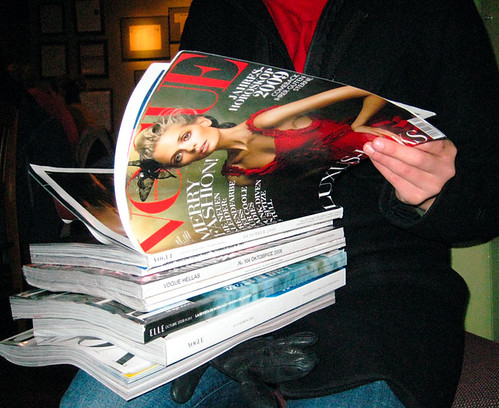
With financial bailouts being handed out to mega-banking institutions and now Detroit automakers, it seems the publishing industry could be in need of the most governmental assistance. The troubled industry is suffering increasingly lower ad revenues and diminishing subscriptions, as more people are turning online to get information personalized and quicker. Print has had a difficult time transitioning to the Internet, and many claim that print is dying. But even in our difficult economy with media layoffs announced daily, new magazines are constantly being launched. So what’s in store for magazines and the Internet?
Richard Maggiotto believes he has the solution: Zinio.com, a website that allows digital subscriptions of major magazines to be e-mailed to readers every month. Zinio has partnered with more than 300 publishers of 1,200 magazine titles including Popular Mechanics, Men’s Health and ELLE. According to Zinio's website, the company currently delivers 20 million digital issues annually to a base of 3.5 million readers worldwide.
Maggiotto started Zinio in 2001 after working in the late 90's at America Online when Time Warner merged with the company. It was up to him to give Time Inc. a digital makeover, and shortly after leaving AOL, Maggiotto took that know-how and began to apply it on a large scale. However the initial reception was not very friendly. “The response to Zinio was not as welcoming as I’d hoped,” Maggiotto said. “I was knocking on many doors. The early days were hard.” Zinio, he said, was treated by magazine publishers as Napster, the now-illegal mp3 downloading software. But really Zinio acts as a marketing agent no different from Barnes & Noble or iTunes. “Essentially the publisher only pays when they have a subscriber. Zinio becomes the U.S. Postal Service.”
But in the last two years, Zinio has seen a resurgence in popularity due to a heightened environmental concern and a desperate industry in the middle of a worldwide economic crisis.
“Publications have to change. In the U.S., 12 billion magazines are printed every year. Seventy percent of those issues are sent back to the publisher. The amount of cost, with printing and mailing—it’s so wasteful!”
“Now magazines recognize the value of it,” he said. “We’re not competing with them. We want publishers to do what they do best—produce incredible content. We’re building the distribution chain for that content.” ELLE is one of the magazines available through Zinio, with subscriptions for digital issues at $12 actually more than ELLE’s current $10 subscription promotion. Cara Buese, digital marketing assistant for ELLE.com and ELLEgirl.com, believes online expansion is the only way to stay viable.
“The magazine industry has completely changed its business model since the advent of the Internet,” she said. “Traditional publishing gained revenue from printed advertising pages, subscriptions, and single copy sales. It is now mandatory for a magazine to have an online presence to sell additional advertising space and complement printed content. I believe the website is even more popular than printed magazines because it allows consumers easy access to content free of charge.”
Along with digital subscriptions, Buese said, magazine websites have become a crucial element of the reading experience.
“It is mandatory for magazines to have an online presence. They serve to enhance and complement the print publication. One goal of a magazine's website is to give incentive to consumers to purchase the print issue. Magazines must now print advertisements that promote its online counterpart. The industry has expanded, as there is a need to ensure there is no disconnect between online content and printed content.”
Buese said French ELLE was the first major fashion magazine to create a website, and competitors like Conde Nast soon followed with Style.com. These sites served as an online database that offers much more content than a reader could find in a single magazine issue. “ELLEgirl Magazine actually folded,” she said, “but continues to remain an active website. The costs of maintaining a website are much cheaper than printing magazines.” Marie Yarbrough, marketing coordinator of Magazines.com, has seen the changes brought about online during her decade in the magazine industry.
“There is definitely a market for digital magazines,” she said of Zinio.com, “but I don’t think it will completely replace print. I think the answer for magazines is to provide consumers with as many options as possible to interact with their brands.”
Yarbrough admits many magazines were slow to establish an online presence but have come on strong in the last couple years. She points to People.com, SportsIllustrated.com, Fortune.com, Businessweek.com, Wired.com and Makezine.com as examples of good online magazine counterparts.
“Magazines need to realize their websites are a way to interact more frequently with their readers. If they don’t recognize this then their competitors will. Editors, writers, designers—everyone—has had to learn how to survive and thrive within the new medium, and now Web 2.0 is forcing magazines to be innovative in ways they never had to consider before.” “To me, the core change seems to be readily available content online, and the decision of how much to make available, for free,” said Lucy Silberman, assistant managing editor for Interview Magazine. “Now magazines are having to not only reproduce current and archival printed material for the web, but to also create new and original (and constantly changing) content.”
Interview Magazine does not offer a digital subscription, and in fact, has even upgraded the quality paper each issue is printed on. Just this month, the magazine relaunched their website. Silberman finds the line between magazine and website to be complicated.
“The idea of free and readily-available content is tricky," she said. "Ideally, you want your website to act as a companion to, rather than replace, the original print publication. With our recently relaunched website we've been able to cover items that didn't make it into the magazine, including interviews, photos, and blogs. Many magazines choose to only offer a taste of the content online, and then direct people to purchase the physical magazine. But the magazine can also direct people to the website.”
CITY Magazine has published digital copies of each issue (“ezines”) for several years through Nxtbook Media, a digital magazine publisher recently named to the Inc. 500. These digitial issues initially cost $1.99 but are now free. These ezines provide the same page-flip format of a printed magazine but provide hyperlinks with certain key phrases and advertisements. “Something like Zinio is part of the answer, the first step,” said Alexander Wolf, design director of CITY Magazine. “ It's a much more faithful representation of a magazine online than what you'd find online more than a few years ago.”
Wolf has also found in a reverse influence, that the Internet has affect the design of print magazines. “Many magazines take visual cues from the digital aesthetic which powers the Internet. Look at any issue of Wired or some of the big consumer magazines and they have tons of sidebars and news nuggets that are decidedly web-ish in their look and feel. Because people are engaging with web sites constantly, their eyes are trained in take in tremendous amounts of information.”
The Internet has “changed the game completely,” said Wolf. “Providing ‘news’ in a print magazine is pretty silly at this point, as you can not beat out the timeliness of a blog or web site. Magazines have to editorialize ‘news’ in an interesting fashion to prove relevant, and the final product on the newsstands is more like a book than it ever was in the past, as a keepsake publication.”
So, are Printed Magazines at the End of their Life?
While no one is denying the unquestionable power of the Internet, the lifespan of print magazines is still under dispute. Magazine aficionados and many of those working in the industry perish the thought of online-only magazines, but others believe it’s the only hope for a troubled industry.
“I’m not trying to say print is dead. Print will exist for a long time to come,” Maggiotto said. “But magazines need to reinvent themselves as brands rather than paper products. They aren’t proprietors of paper—magazines don’t own the printers they’re printed on. They own the content.”
Maggiotto points to new technology, like WiFi ubiquity and flexible reading screen displays such as Sony’s OLED, as tools to help magazines in the future. He said Zinio is working on a screen in 2009.
With 18,000 magazines in the United States alone, Maggiotto believes the tough economic climate will shake out a lot of titles. Buese agrees, citing the rising cost of printing magazines over website expenses.
“I believe we’ll see further web integration in the future,” Buese said. “However, I do not think the print industry will cease to exist, particularly for art, culture, and women's fashion magazines. There is a tactile experience in touching a glossy magazine with color photos that can’t be had by browsing online photos.”
“It's a tough time for print media,” Silberman said. “That said, there are still people who impatiently check the mailbox every day, waiting for their subscription to arrive. , I think many readers feel you lose something when magazines or newspapers are wholly digital. Personally, I tend to read print publications more closely; you might stumble upon content that you wouldn't have looked at if you were casually browsing online. Only time will tell whether or not print magazines are a dying breed.”
Showing posts with label Online competition. Show all posts
Showing posts with label Online competition. Show all posts
Wednesday, December 10, 2008
Is Print Dead?

Wednesday, September 17, 2008
All Hail the Supplement!
 Image from Men.Style.Com
Magazine lovers are told constantly that the publishing world, facing many reported financial challenges, will soon cease to exist giving way solely to online reading. To those that keep magazines on their bookshelf as prized possessions, this prediction never fails to break our heart. It comes as a surprise then that the nation's two major newspapers, doing much worse than magazines in terms of retaining print readers, release new magazine supplements to their papers.
The Wall Street Journal unveiled its much anticipated magazine WSJ. this month to compete with the New York Time's existing T Magazine. Aside from the fact that the initial-only names are uninspired and trying-too-hard (and yes, that period is purposefully in WSJ.), this marks a positive sign in the allure of glossy magazines to both readers and advertisers. Men.Style.Com rates the two, declaring T the winner, but the WSJ. debut feels much more foreboding.
Its cover story shows model Diana Dondoe in an amateur-looking newspaper dress against a colorless backdrop. The Wall Street Journal is not known for its critical fashion coverage, and it shows. The story, however, asks how the luxury industry must evolve in order to survive. WSJ. must be in denial because really that is the very question they should be asking themselves.
Other newspapers around the country are also trying their hand in fashionable glossy supplements, like the Boston Globe's Fashion Boston, but their efforts come up inept. Even for a magazine connoisseur like myself, using them for wiping seems their only practical use.
These struggling and stodgy institutions believe that the invaluable 20 to 30-something audience, which opts for GoogleNews instead of newspapers, still have an interest in reading magazines and looking at printed photographs instead of digital ones. Plus, luxury and fashion companies still rely on magazines as a primary source of advertising, just as magazines rely heavily on them for income. So in the face of adversity, we now have two new magazines to ogle at each month.
Subscribe to:
Posts (Atom)

 Posts
Posts


